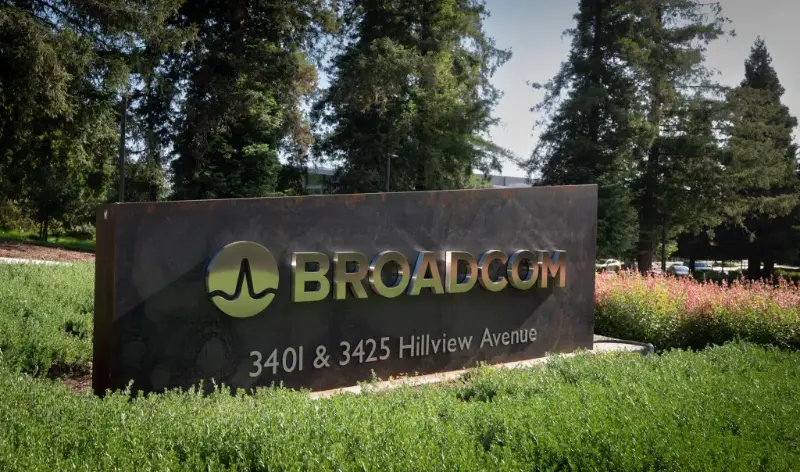
Broadcom’s latest earnings update delivered the kind of numbers that usually quiets a room: record quarterly revenue, surging AI demand, and a forecast that again moved higher. Yet the company’s shares slipped in extended trading anyway, a reminder that in the AI boom, investors are no longer grading on growth alone—they’re also scoring the quality of that growth, the visibility behind it, and the margins that come with it.
For its fiscal fourth quarter, Broadcom reported revenue of about $18.0 billion, up 28% from a year earlier, with adjusted EBITDA above $12 billion. Management framed fiscal 2025 as a decisive step-change year: consolidated revenue reached roughly $64 billion, powered by two engines—AI semiconductors and VMware—while free cash flow remained robust.
The company’s AI revenue line, which Broadcom has been increasingly explicit about, rose to $20 billion for the year, with CEO Hock Tan describing a trajectory that has expanded more than tenfold over the 11 quarters the firm has reported the category.
The near-term outlook was, on its face, even louder. Broadcom guided fiscal first-quarter revenue to about $19.1 billion, up 28% year over year, with semiconductor revenue expected to jump roughly 50% and AI semiconductor revenue projected to double to $8.2 billion.
But the same guidance contained the detail that spooked the market: gross margin is expected to fall around 100 basis points sequentially, largely because AI is becoming a bigger share of the mix—and because Broadcom is leaning further into “systems” sales that include more third-party components passed through at lower margin.
That tension—more AI, less margin—is now a central feature of the Broadcom story. On the call, Tan and CFO Kirsten Spears were unusually candid that as AI ramps and more rack-level systems ship, corporate gross margins will likely compress even as gross profit dollars rise. Operating margin, they argued, can be supported by operating leverage: Broadcom’s expense base doesn’t need to grow at the same speed as AI revenue, even if the hardware bundle becomes more component-heavy.
Under the hood, Broadcom’s AI narrative is less about a single chip than a portfolio of “must-have” plumbing for modern model training and inference. The company described accelerating demand for custom accelerators—its XPUs—alongside AI networking, including its Tomahawk 6 switch silicon, optical DSPs, PCIe switches, and laser components.
Management highlighted an AI-related order book exceeding $73 billion—nearly half of the company’s total backlog—expected to be delivered over the next 18 months, while also stressing that the figure is a snapshot that can grow as new orders come in.
Customer concentration is the other subplot investors are increasingly unwilling to ignore. Broadcom pointed to a $10 billion order disclosed last quarter for Google’s latest TPU “Ironwood” racks for Anthropic, followed by an additional $11 billion order for delivery in late 2026, plus a new $1 billion order tied to a fifth custom-accelerator customer.
The company also addressed speculation around OpenAI by distinguishing between a longer-dated “alignment” to support 10 gigawatts of capacity in 2027–2029 and the separate, more advanced custom-accelerator development effort—while noting it does not expect much related revenue in 2026.
For the broader AI field, Broadcom’s comments reinforce a shift already underway: hyperscalers and top AI labs aren’t simply buying more GPUs; they’re increasingly building differentiated stacks, mixing merchant GPUs with purpose-built accelerators, and investing heavily in interconnect and networking to scale clusters. Tan argued that the idea of customers “doing it all themselves” is overblown, because keeping pace with leading-edge silicon evolution is a relentless, specialized race—one where Broadcom positions itself as the design-and-supply partner rather than the brand-name compute provider.
At the same time, the company’s own move toward system-level responsibility suggests the AI supply chain is maturing from a chip land-grab into an integration game, where packaging, memory, and rack-level delivery become strategic bottlenecks.
In that sense, Broadcom’s quarter read like a progress report on the industrialization of AI. The spending is still accelerating, but the questions are getting more prosaic: who controls the architecture, who can secure advanced packaging capacity, and what happens to profitability when “AI revenue” starts to look less like high-margin silicon and more like a delivered, working system. Investors may have flinched at that reality in the after-hours tape, but it’s also the strongest signal yet that AI is moving from prototype to infrastructure.
#avgo